The RRSP Time Bomb at 71 — and How Linda Defused It Early

Written by
Theo NakamuraCFP, CLU
Theo is a Certified Financial Planner and Chartered Life Underwriter based in Ottawa who specializes in retirement income and decumulation. After 15 years helping Canadians turn a lifetime of savings into a dependable retirement paycheque, he writes about CPP and OAS timing, RRIF and LIF withdrawals, tax-efficient drawdown, and estate planning.
AI Generated by TrackMoola
A great problem to have — until it is not
Linda is 58, a senior engineer in Winnipeg, and a wonderfully disciplined saver. For three decades she funnelled every spare dollar into her RRSP, and it worked: she has built a large balance that most Canadians would envy. So she was genuinely surprised when, sitting down to plan, she discovered that her great success had a built-in trap — one that goes off at the end of the year she turns 71.
It is a problem more Canadians should know about, because the people most exposed to it are exactly the diligent savers who think they are safe.
That is the irony Linda kept coming back to. The trap does not catch people who saved too little — they have small RRSPs and small forced withdrawals, and no clawback to worry about. It catches the people who did everything financial advice told them to do: contribute aggressively, never withdraw early, let it compound. The bigger and more successful the RRSP, the harder the forced withdrawals can hit later. In a sense, it is a penalty for being good at saving, which is precisely why it blindsides the very people who feel most prepared.
What actually happens at 71
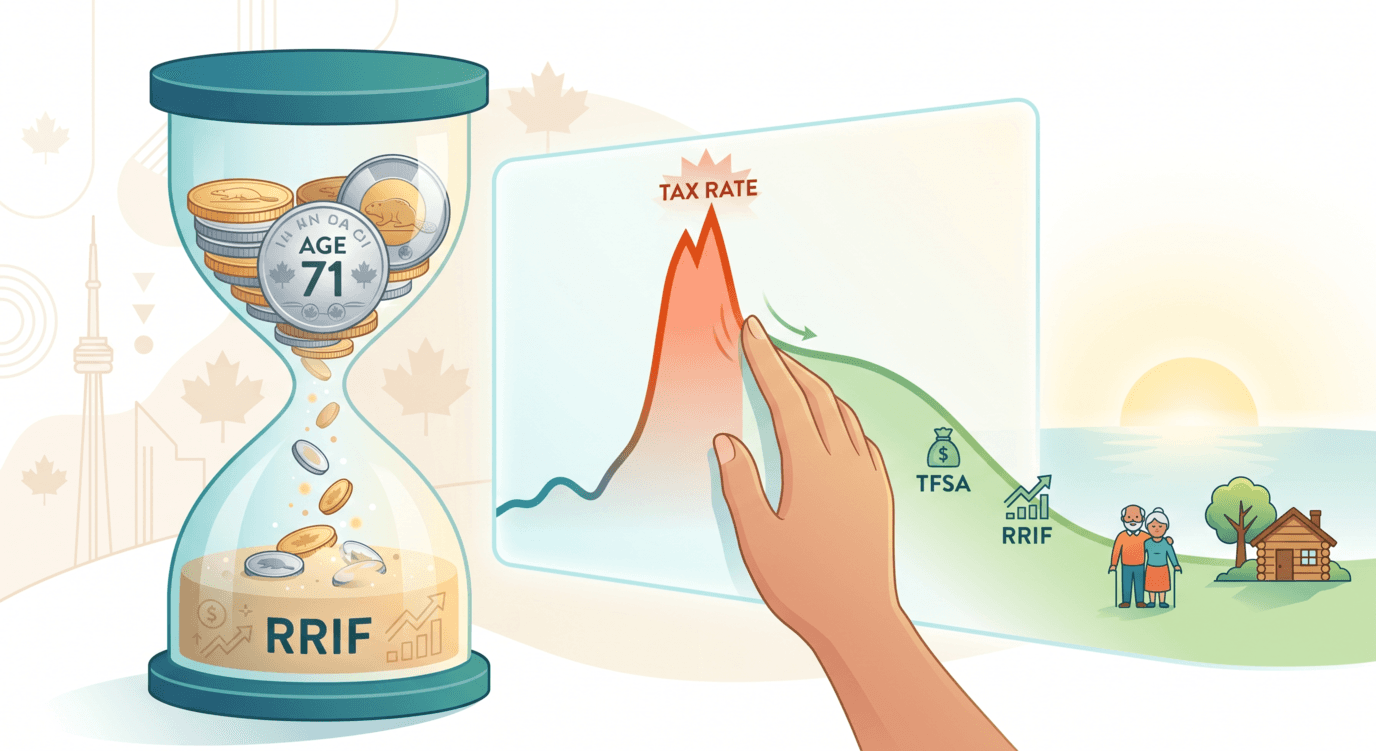
Here is the public rule, and it is worth understanding clearly. By the end of the year you turn 71, your RRSP can no longer just sit there. You must convert it — most people roll it into a Registered Retirement Income Fund, or RRIF. And once it is a RRIF, the government requires you to withdraw a minimum percentage every single year, whether you need the money or not. That percentage is modest at first but climbs steadily as you age.
Every dollar that comes out of a RRIF is taxed as ordinary income. So if you arrive at 71 with a very large RRSP, the forced minimum withdrawals can be substantial — and they stack on top of CPP, OAS, and any other income you have. For a saver like Linda, that can mean being pushed into a higher tax bracket in her seventies than she was in during her working years.
The OAS clawback piece
There is a second sting. Old Age Security is subject to a recovery tax — commonly called the clawback. Once your net income passes a threshold set each year by the CRA, you begin repaying OAS at a rate of 15 cents for every dollar of income above that line. Large mandatory RRIF withdrawals are one of the most common reasons retirees blow past that threshold without meaning to. So the time bomb is really a double charge: more income tax, and a chunk of your OAS quietly recovered.
"I spent thirty years being told the RRSP was the responsible choice," Linda said. "Nobody mentioned that all that tax was just deferred, not cancelled — and that it could all come due at once."
Why earlier is the lever
The insight that changed Linda's plan is simple to state. The tax on an RRSP is not avoided; it is postponed. You will pay it eventually — the only real question is at what rate. If you leave the entire balance untouched until forced withdrawals begin, you risk paying at a high rate, all bunched together. But the years between retiring and turning 71 are often lower-income years, when your tax rate is lower and there is room to take money out more cheaply.
Drawing some of the RRSP down early — deliberately, in those lower-tax years — means less is left to be forced out at high rates later. You are not avoiding tax; you are choosing to pay some of it while it is cheap, so that less of it comes due when it would be expensive. That is the whole idea behind smoothing a lifetime tax bill.
There is a refinement worth knowing about, too. Money you draw early does not have to be spent. If you do not need it for living expenses, it can often be moved into a TFSA — where it grows tax-free from then on and, crucially, never counts toward the income that triggers the clawback later. So the early withdrawal can do double duty: it shrinks the future RRIF that would have been force-fed at high rates, and it quietly rebuilds wealth in the most flexible, tax-friendly account a Canadian has. Linda found that idea especially appealing, because it did not require her to spend a cent more than she had planned.
What Linda did with the planner
Linda used TrackMoola's retirement planner to see her future tax bills laid out year by year — both the "do nothing until 71" path and an alternative where she drew measured amounts from the RRSP in her early retirement years. She did not have to work out the mechanics herself; the planner let her compare the two paths and see the lifetime tax result of each, side by side. The contrast did the convincing.
The "do nothing" path showed a comfortable stretch in her sixties followed by a sharp jump in tax once forced withdrawals began — with OAS clawback making an unwelcome appearance. The smoothed path traded a little more tax in the early years for a much flatter, lower bill overall.
Seeing it as a chart rather than a paragraph made it click. The "do nothing" line stayed low and pleasant for years, then leapt upward and stayed high — the shape of a bill she had simply deferred, not reduced. The smoothed line rose a little sooner but never spiked, settling into a gentle, manageable slope. Linda described it as the difference between a wall and a ramp. She would rather walk up a ramp she could see coming than run face-first into a wall in her seventies, and the comparison made that choice feel obvious rather than technical.
| Measure | Leave RRSP until 71 | Draw down early to smooth |
|---|---|---|
| Tax in early retirement | Very low | Slightly higher |
| Tax spike in the 70s | Sharp | Largely flattened |
| OAS clawback exposure | Significant | Greatly reduced |
| Estimated lifetime tax | Baseline | About $45,000 lower |
For Linda's situation, smoothing the withdrawals out over more years pointed to roughly $45,000 less in lifetime tax — money kept rather than handed over to a forced-withdrawal spike she never had to walk into. These figures are illustrative; they describe Linda's accounts and goals, not yours.
Why finding out at 58 mattered so much
The single biggest advantage Linda had was time. Someone who discovers this trap at 70 has essentially one year of runway and very little room to manoeuvre — any catch-up withdrawals have to be crammed into a short window, often at rates that defeat the purpose. Linda, at 58, had more than a decade. That let her plan to draw the RRSP down in small, gentle slices, spread across many low-income years, never taking so much in any single year that it pushed her into a higher bracket. Gradual is the whole game, and gradual requires runway.
She also liked that the plan was not set in stone. Because she was looking this far ahead in TrackMoola's retirement planner, she could revisit it each year as her circumstances, the tax brackets, and the thresholds changed, and adjust the pace. It was less a one-time decision and more a dial she could turn a little at a time. That flexibility — only possible because she started early — is what turned a frightening "time bomb" into something almost mundane.
The mental shift that mattered most
What struck Linda was not just the dollars — it was realizing she had a window, and that the window had a closing date. The years between now and 71 were a genuine planning opportunity, and every year she waited was one fewer low-tax year to work with. Because she found this out at 58 rather than at 70, she had over a decade of room to act gradually and gently, rather than scrambling at the last minute.
What her story illustrates
- A large RRSP is a deferred tax bill, not a tax-free one — the bill comes due, the only question is the rate.
- Forced RRIF minimums at 71 and beyond can spike your taxable income and trigger OAS clawback.
- Low-income early-retirement years are a limited-time opportunity to draw the RRSP down more cheaply.
- Finding out early gives you the most valuable thing of all: time to act gradually.
Try it yourself
If you have built a substantial RRSP, do not wait until 71 to find out what it means for your taxes. Model your own balances in TrackMoola's retirement planner, look at your projected tax bills year by year, and compare leaving the RRSP alone against drawing it down gradually. Seeing your own version of Linda's two paths is the clearest way to decide whether there is a time bomb worth defusing — and how much time you have to do it.
Your results will be different. The numbers in this story describe one person's situation and goals — they are illustrative, not a promise or a benchmark. The only way to know what these decisions mean for you is to run your own analysis in TrackMoola with your real accounts, income, and goals. This article is general education, not financial, tax, or legal advice.