Your Pre-Retirement Year-End Checklist (Age 55-71)

Written by
Theo NakamuraCFP, CLU
Theo is a Certified Financial Planner and Chartered Life Underwriter based in Ottawa who specializes in retirement income and decumulation. After 15 years helping Canadians turn a lifetime of savings into a dependable retirement paycheque, he writes about CPP and OAS timing, RRIF and LIF withdrawals, tax-efficient drawdown, and estate planning.
AI Generated by TrackMoola
The Stretch That Decides So Much
Lise Bergeron is fifty-eight and lives in Quebec City. She has been a registered nurse for most of her adult life, she is roughly three years from the retirement she has been picturing, and for the past few months she has carried a quiet, unfocused worry about whether she has everything lined up. Not panic, exactly. More the sense that there were decisions waiting for her and she was not sure she had made them yet.
This autumn, instead of letting that feeling drift into another year, she sat down at her kitchen table with a cup of tea and built herself a year-end checklist. The stretch between age fifty-five and seventy-one is where some of the most consequential retirement decisions get made, and Lise wanted to face them on purpose rather than by accident.
Why These Years Are Different
For most of your working life, the financial advice is gloriously simple: earn, save, repeat. The years just before retirement are different because several big levers all come live at once, and they interact. When you start your Canada Pension Plan benefit, when you take Old Age Security, how much room is left in your RRSP, how you will eventually turn it into income, and which tax bracket all of that lands you in are no longer abstract questions. They are decisions with deadlines.
The danger is not making a wrong choice so much as making no choice and letting defaults decide for you. A year-end review in this window is how you take the wheel.
What makes these decisions genuinely hard is that they do not stand alone. The age you start CPP changes how much taxable income you have, which changes which bracket your RRSP withdrawals land in, which changes whether your Old Age Security gets clawed back. Pull one lever and the others move. That is precisely why a checklist you work through in your head rarely settles anything: the human mind is not built to hold five interacting variables at once. Writing the list down, and then seeing the pieces modelled together, is what turns an impossible mental juggle into a set of manageable choices.
Lise also wanted a baseline sense of her overall financial footing before diving into the timing questions, so she first glanced at her financial health score to confirm her savings, debt, and net worth were where she thought they were. With that reassurance in hand, she felt ready to tackle the bigger decisions.
Lise's Year-End Checklist
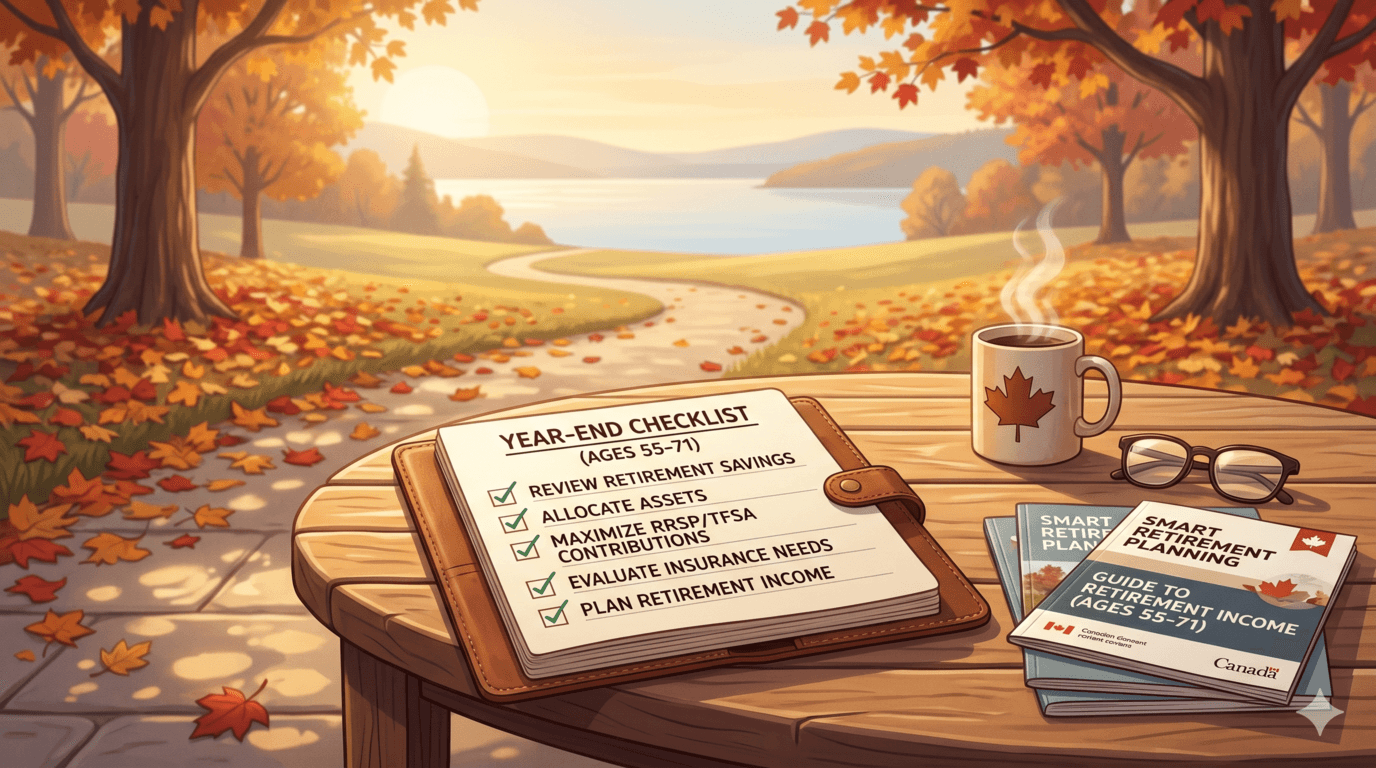
Lise kept her checklist deliberately short and concrete. These were the items she worked through:
- RRSP and RRIF runway. How much is in the RRSP, and what will it look like once it has to become a RRIF with mandatory minimum withdrawals? Is there a case for drawing some down earlier, in lower-income years, rather than letting it all come out later in a rush?
- CPP timing. Start the Canada Pension Plan as early as sixty, take it at sixty-five, or delay toward seventy for a larger monthly amount? The longer you wait, the bigger each cheque, but the fewer years you collect.
- OAS timing. Old Age Security can begin at sixty-five or be deferred for a higher amount, and high income can trigger a clawback, so the timing interacts with everything else.
- TFSA room. Is there unused TFSA contribution room that could hold tax-free savings, and could some money be shifted there to provide flexible, non-taxable income later?
- Tax brackets. Across all of the above, which bracket does each year land in, and are there cheap brackets going to waste that could be filled deliberately?
None of these items has a universal right answer. The point of the checklist was not to find the textbook move. It was to make sure each decision got considered rather than ignored.
What TrackMoola Showed Her
Lise did not want to weigh five interacting decisions in her head. She entered her accounts, her expected pension, and her retirement timing into the TrackMoola planner so she could see how the pieces moved together across the years ahead rather than one at a time.
The planner let her see her whole runway laid out. She could watch what her income looked like year by year under different choices: starting CPP earlier versus later, leaving the RRSP alone versus drawing it down gradually, leaning on the TFSA for flexibility. Seeing the years side by side made something click that no single calculation had. In some scenarios her income was lumpy, with low early years and a spike once RRIF minimums kicked in. In others it was far smoother, and TrackMoola showed her the smoother path used up the cheap tax brackets she would otherwise waste.
| Decision area | What she could see | The clarity it gave |
|---|---|---|
| RRSP and RRIF runway | Income shape across the years | Whether to draw early or wait |
| CPP timing | Earlier smaller vs later larger | How it fit her other income |
| OAS timing | Start vs defer, clawback exposure | How to protect the benefit |
| TFSA room | Flexible tax-free income later | Where to add cushion |
| Tax brackets | Wasted vs filled cheap room | How to smooth the bill |
The specific numbers are Lise's own and we are keeping them general here. What mattered was not a single figure but the overall shape: a calmer, more even income path and a clear sense of which decisions to keep weighing as her retirement date approaches.
The Big Shift in How She Felt
The most striking change was emotional. Lise walked in with a fuzzy worry and walked out with a short list of specific, considered choices. She did not have to lock everything in three years early. She simply needed to know she had looked, and to have a working plan she could revisit.
"The worry was really just not knowing," Lise says. "Once I could see the whole runway, it stopped being scary. It became a plan I could adjust, not a cliff I was about to walk off."
That distinction — a plan you adjust versus a cliff you walk off — captures something many near-retirees feel without being able to name it. The fear of retirement is rarely about the math itself. It is about the irreversibility, the sense that you get one shot at decisions like when to start CPP and you had better not get them wrong. Seeing the runway laid out dissolved that fear for Lise because it showed her the decisions were not a single irreversible leap but a series of adjustable steps, each one informed by the last. She could lean one way this year and reconsider next year as her picture sharpened.
She decided to make the checklist an annual autumn ritual, revisiting it each year as her retirement date drew closer and her numbers firmed up. Decisions like CPP and OAS timing do not have to be made today, but they do have to be made eventually, and reviewing them yearly means none of them sneaks up on her.
There is real wisdom in revisiting rather than deciding once. Markets move, tax rules shift, and your own plans change — Lise might decide to work an extra year, or to retire a year sooner, and either choice would reshuffle the answers. A plan made three years out and then locked in a drawer would almost certainly be wrong by the time she needed it. A plan she revisits each autumn, by contrast, stays current and lets her adjust gradually, so the version she carries into her first day of retirement is one she has refined several times rather than guessed at once.
She found the yearly cadence reassuring in another way too. The first time through the checklist, several items felt daunting and unresolved. The second time, she expected, they would feel more familiar, and a few would have settled into place. Treating retirement readiness as something you grow into over a few annual reviews, rather than a single high-stakes exam, took most of the pressure out of it.
Borrowing Lise's Checklist
If you are anywhere in the fifty-five to seventy-one window, her list is a sensible starting point. Walk through each item once a year:
- Map your RRSP and RRIF runway and ask whether early, gradual withdrawals make sense for you.
- Weigh CPP timing against your other income sources.
- Weigh OAS timing and watch for clawback exposure.
- Check for unused TFSA room that could provide tax-free flexibility.
- Look across every year at your tax brackets and notice where cheap room is going to waste.
The answers will be different for everyone, because the balances, ages, pensions, and goals are different. What stays the same is the value of considering each decision on purpose, with your whole runway in view.
Try It Yourself
If retirement is somewhere on your horizon and you have a low hum of "am I ready?" in the back of your mind, give yourself the year-end review Lise gave herself. Use the TrackMoola planner to map your full runway and see how RRSP drawdown, CPP and OAS timing, TFSA room, and your tax brackets move together. Seeing the whole picture is usually what turns the worry into a plan.
Your results will be different. The numbers in this story describe one person's situation and goals — they are illustrative, not a promise or a benchmark. The only way to know what these decisions mean for you is to run your own analysis in TrackMoola with your real accounts, income, and goals. This article is general education, not financial, tax, or legal advice.